ZHANHAN YU

2019 Summer in Boston.
PUBLICATION
Heat and Productivity: Evidence from Flight On-Time Performance
with Ying Shi
Journal of the Association of Environmental and Resource Economists 12, no. 5 (2025): 1243-1275.
(https://doi.org/10.1086/733369)
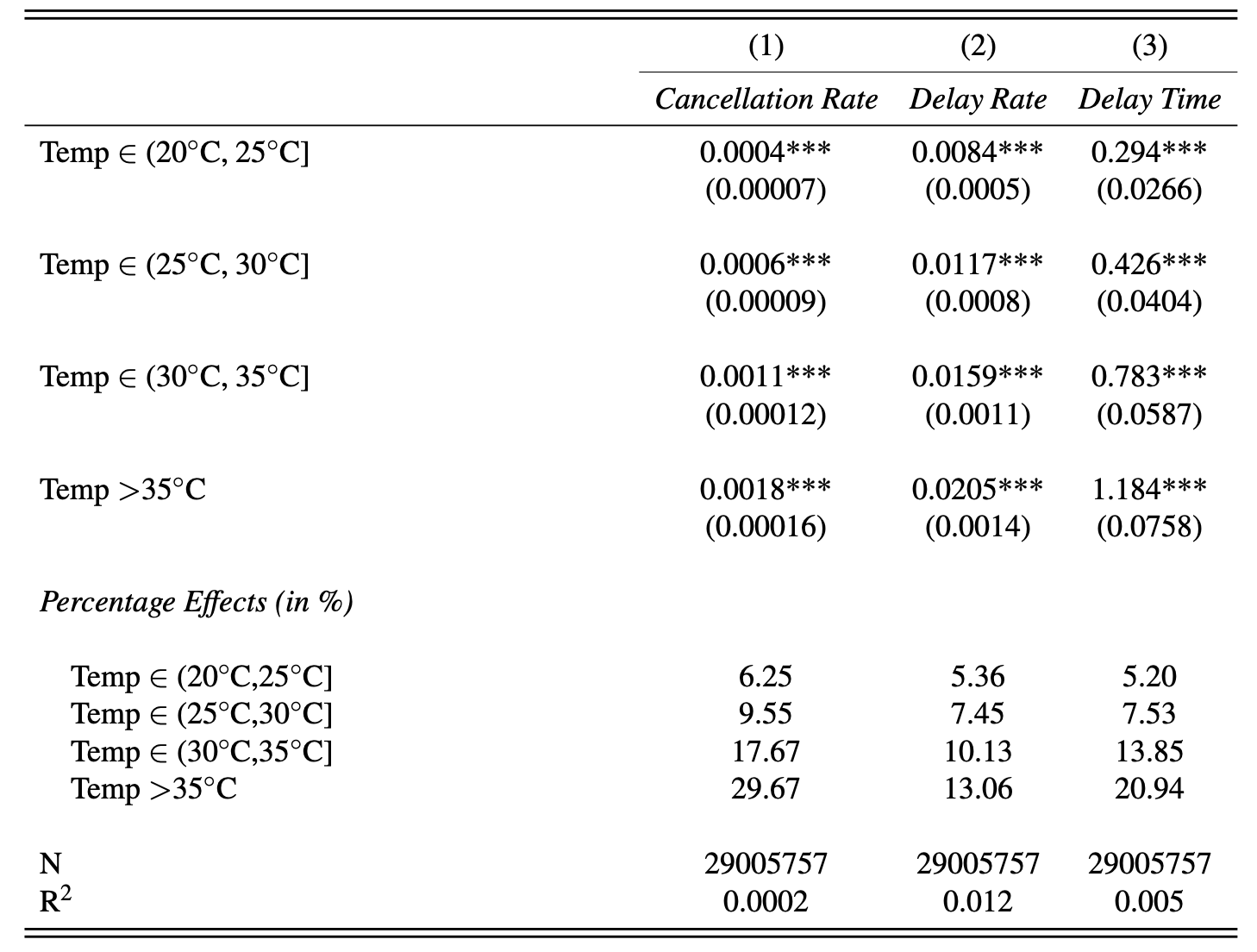
We investigate the impact of high temperatures on productivity using microdata from the U.S. airline industry. By linking high-frequency on-time flight performance measures with meteorological data, we show that higher temperatures significantly reduce airline productivity by increasing cancellation and delay rates and lengthening delay times. Using the American Time-Use Survey (ATUS), our complementary analyses suggest that the impact of higher temperatures operate in part through decreased labor supply (fewer hours worked and greater worker absenteeism) as well as reduced sleep quality and well-being, which may affect on-the-job productivity.
Highlights
- We find that flights operating during days where temperatures are greater than 35 degrees Celsius are 30% more likely to be cancelled, 13% more likely to involve a late departure, and experience 21% longer delay time conditional on late departure.
- An additional hour of heat exposure during the day is estimated to increase the departure delay rate and delay time later in the same day by 4% and 3%, respectively.
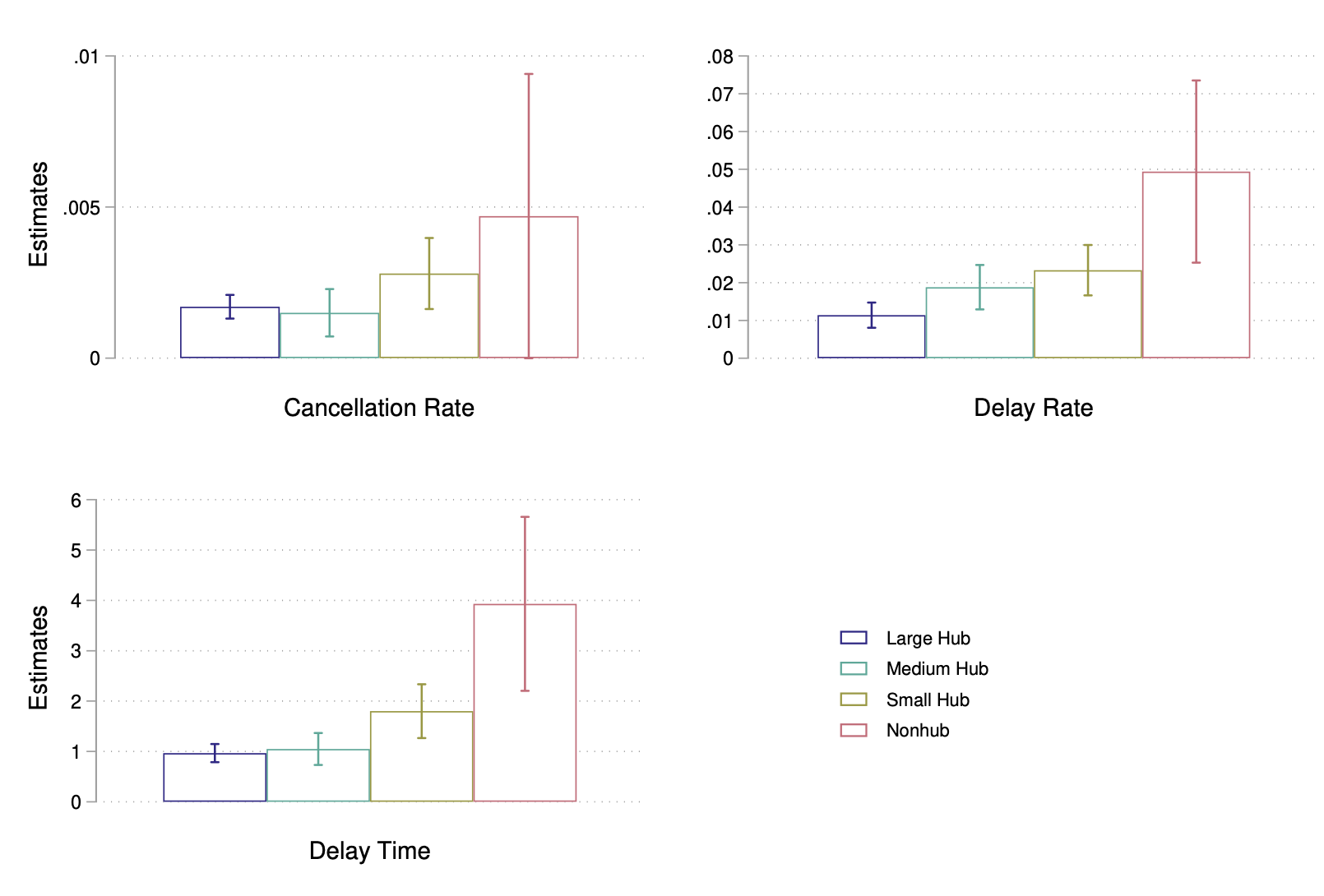
- The heat's impacts are decreasing in airport size, with nonhub airports more negatively affected than large and medium hub airports.
- We provide suggestive evidence on the mechanisms behind these estimates: a) Heat reduces hours worked (by 1.2-1.4 hours for transportation workers) and increases absenteeism; b) Heat exposure decreases workers’ sleep time and increases the probability of experiencing sleeplessness; c) The mechanism of sleep quality does not meaningfully influence workers’ labor supply.
Monopsony in Academia and the Gender Pay Gap: Evidence from California
Labour Economics 100, June 2026, 102885
(https://doi.org/10.1016/j.labeco.2026.102885)
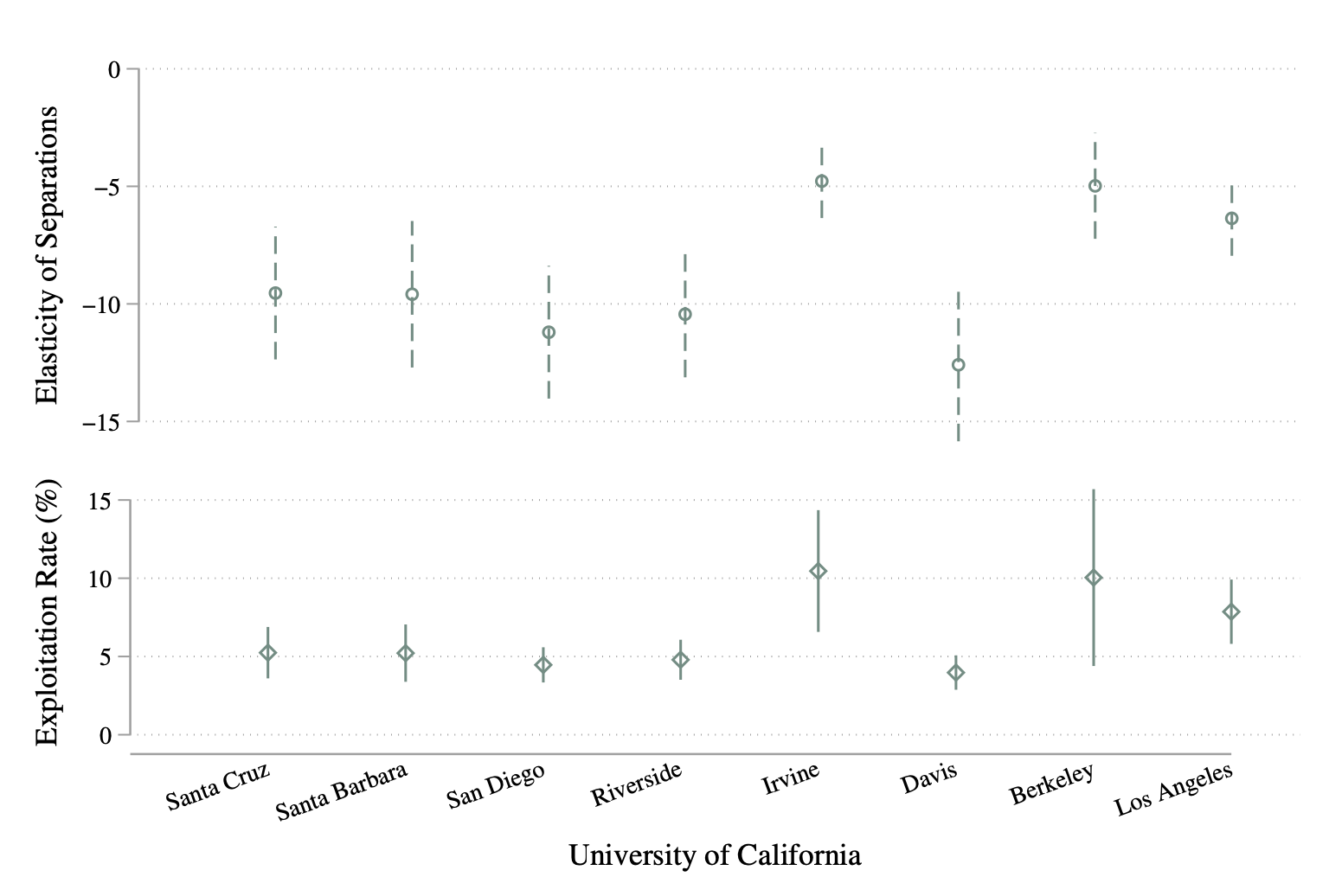
We investigate monopsony power in a highly-skilled labor market given by tenure-ranked faculty in the University of California system, and analyze differential monopsony power exposure by gender. We infer the campus-level labor supply elasticity by estimating the elasticity of separations utilizing individual-level faculty data and two instruments based on campus revenues and salary scales. We find that the “exploitation rate,” a common measure of monopsony power, is about 7% for tenure-ranked faculty. There is a statistically significant difference in the monopsony power experienced by male and female faculty that appears to account for a relatively small percentage of the observed gender pay gap. We provide evidence that the gender difference in monopsony power experienced may be driven by academic fields with more options outside of academia.
Highlights
- We find evidence that monopsony exists in the UC labor market for tenure-ranked faculty: the exploitation rate is robustly estimated at 7%.
- While we do not find statistically significant differences in the exposure to monopsony power across faculty groups, such as tenured/non-tenured and U.S./foreign born, we do find heterogeneity in the monopsony power across campuses, which could be related to their location.
- Male and female faculty members experience a statistically different level of monopsony power: on average, female faculty face a 1.3 pp (percentage point) higher exploitation rate relative to male faculty. This difference is driven by those faculty born in the U.S., among whom females experience a 2 pp higher level of monopsony power.
- The differential exposure to monopsony power would represent relatively little (7 to 11%) of the observed gender pay gap in the UC system. We conjecture that this is the result of the institutional setting we examine: campuses with salary transparency and public pay scales.
WORKING PAPER
Carbon Footprint of Place-Based Economic Policies
with Sayahnika Basu and Yao Wang
We evaluate the unintended environmental impacts of Special Economic Zones (SEZs), a place-based policy aimed at promoting economic development in India and characterized by non-energy related tax holidays, on firms’ energy use and carbon emissions. Using detailed firm level energy data and a Difference-in-Differences design combined with matching, we find that firms located within SEZs reduce their carbon emissions by 22% compared to comparable firms outside SEZs. This reduction is driven primarily by the adoption of newer, cleaner capital rather than by declines in output. We also find suggestive evidence of a shift in energy composition away from conventional fossil fuels toward cleaner energy sources. Emission reductions are larger among bigger firms, non-manufacturing firms with greater energy-substitution flexibility, and firms in regions with better access to clean energy infrastructure.
Rerouting Externalities: Flight Diversions and Local Health
with Alex Yu
Transportation networks absorb disruptions by rerouting activity, shifting local externalities toward communities that did not generate the disruption. We study this rerouting mechanism through flight diversions, linking flight diversion records to neighborhood Emergency Medical Services dispatches in New York City. Using disruptions elsewhere in the air network as an instrument for diversion exposure, we find that greater exposure increases EMS demand, especially in neighborhoods closest to airports and late-night diversions. Delayed scheduled arrivals generate markedly different responses, indicating that spatial reallocation, rather than late arrival alone, contributes importantly to the EMS response. The 2016 relaxation of slot controls at Newark Airport was followed by diversion activity shifting toward the region’s other major airports, and higher EMS demand in nearby communities. The findings illustrate how disruptions and airport-capacity policies can redistribute aircraft activity and associated health burdens across connected airports and surrounding communities.
Air Pollution, Workplace Safety, and Productivity: Evidence Beyond LATE
This paper studies the causal effect of air pollution on workplace safety in the United States using novel nationwide administrative data on severe workplace injuries. Moving beyond the standard method that exploits instrumental variable to address endogenous air pollution and identify the local average treatment effect (LATE) for compliers, this study applies partial identification approaches based on weaker assumptions to recover informative bounds on the average treatment effect (ATE). I find that PM2.5 pollution raises the incidence of severe workplace accidents. Counterfactual reductions in high-pollution days yield sizable economic benefits, equivalent to at least 9% of the EPA’s annual air-pollution control expenditures.
The Changing Monopsony Power in Higher Education: Evidence without Instruments
with Linqi Zhang
This study investigates the dynamics of universities’ wage-setting power in a public system located in a “red” state that has undergone major tenure-policy changes. Facing challenges due to the absence of valid instruments and with an endogenous, potentially mismeasured salary variable, we propose a method to estimate monopsony power without instruments while accounting for measurement error in the endogenous regressor. We find substantial wage-setting power, exceeding both the national average and that of a comparable public system in a “blue” state. The estimated monopsony power declined during the policy-change period and rebounded in the COVID period.